What Medicare covers · Cancer screening · New Mexico
Does Medicare Cover Lung Cancer Screening in New Mexico?
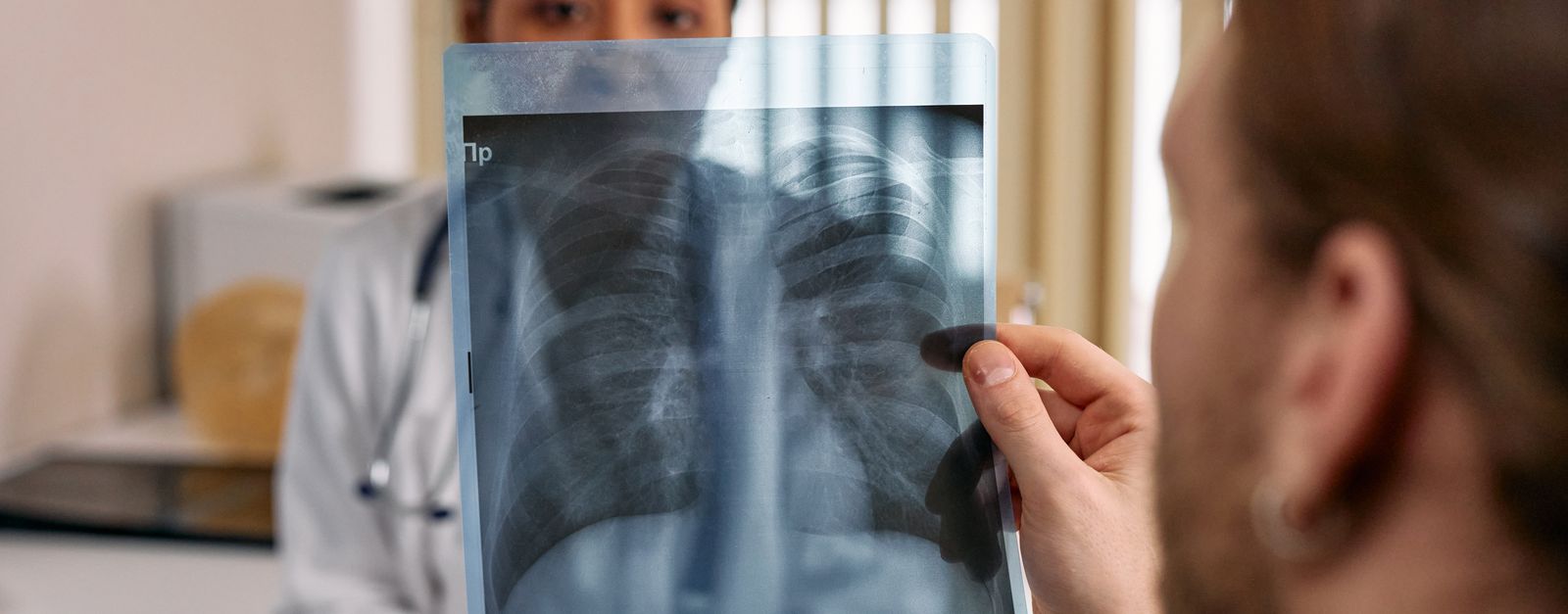
Yes, once a year at no cost, if your smoking history fits Medicare's rule. Here is how to work out whether you qualify, what the first appointment involves, what changes if the scan finds a spot, and what New Mexico's own claims and smoking data show.

The bottom line
- Covered: one low-dose CT lung scan a year under Part B, for $0 when the provider accepts assignment.
- Who qualifies: age 50 to 77, no lung symptoms, at least 20 pack-years of smoking, and either still smoking or quit within the last 15 years.
- First step: a counseling and shared decision-making visit with your provider, then an order for the scan.
- The catch: if the scan finds something, the follow-up CT is a diagnostic test with the usual Part B deductible and 20%.
- New Mexico: Original Medicare paid for 1,699 screening scans here in 2024, while 10 of 33 counties have adult smoking rates of 15% or more.
Medicare's answer, in one paragraph
Medicare Part B covers a lung cancer screening with low-dose computed tomography (a low-dose CT scan) once a year if you meet every condition on Medicare's list: you are between 50 and 77, you have no signs or symptoms of lung cancer, you smoke now or quit within the last 15 years, you have a smoking history of at least 20 "pack years," and your provider orders the test. "You pay nothing if your doctor or other health care provider accepts assignment" (Medicare.gov, Lung cancer screenings). Those terms come from CMS's national coverage decision, which was widened on February 10, 2022 (CMS decision memo CAG-00439R).
That rule applies to every Medicare plan in New Mexico. If you are choosing a 2027 plan this fall, our guide to comparing Medicare Advantage plans in New Mexico explains where to check a plan's imaging network and specialist copays, the two places a lung screening can lead. This page covers the screening itself.
Do I have 20 pack-years?
A pack-year is Medicare's way of measuring how much you have smoked over your life: the number of packs a day times the number of years. Medicare.gov gives the example of "one pack (20 cigarettes) per day for 20 years" (Medicare.gov). Lighter smokers can still reach 20 if they smoked for a long time, and heavy smokers can reach it in fewer years.
| Smoking history | Pack-years | Against Medicare's rule |
|---|---|---|
| 1 pack a day for 20 years | 20 | Meets the 20 pack-year minimum |
| Half a pack a day for 40 years | 20 | Meets the minimum |
| 2 packs a day for 10 years | 20 | Meets the minimum |
| Half a pack a day for 30 years | 15 | Falls short |
| 5 cigarettes a day for 50 years | 12.5 | Falls short |
Pack-years = packs smoked per day × years smoked. A pack is 20 cigarettes. Our arithmetic using the definition on Medicare.gov.
Few people know their number offhand. Add up the stretches: 15 years at a pack a day in your twenties and thirties, then 10 more at half a pack, is 15 + 5 = 20. Your provider will ask and write the figure in the order, so work it out before the appointment. Medicare's rule counts cigarettes. If most of your tobacco use was something else, ask your provider how it counts.
I quit years ago. Am I still covered?
Only if you quit within the last 15 years. CMS kept the 15-year quit window when it widened the rule in 2022, so someone who stopped smoking 16 years ago doesn't qualify for the yearly screening, however heavy the smoking was before (CMS decision memo, 2022).
The window moves every year. If you quit in 2013, the 2027 screening may be one of your last covered ones. Ask your provider to note your quit date in your chart so each year's order is easy to write.
The age range works the same way. Coverage starts at 50 and ends after 77. If a doctor orders a chest CT because you have a cough that won't go away, coughing up blood, or weight loss you can't explain, that is a diagnostic test, not a screening, and the age and smoking rules don't apply. It is billed differently, though, as the cost section explains.
The visit before your first scan
Before your first screening, Medicare requires a separate conversation with your provider "to discuss the benefits and risks and decide if a screening is right for you" (Medicare.gov). CMS calls it a counseling and shared decision-making visit, and the coverage decision says it must include (CMS decision memo, 2022):
- Confirming you qualify: your age, that you have no symptoms, your pack-years and, if you've quit, the year you quit.
- Shared decision-making with at least one decision aid, a handout or tool that lays out the trade-offs: the chance of catching a cancer early, false alarms, follow-up tests and radiation.
- Why yearly screening matters, and how other health problems might affect whether treatment would be worthwhile for you.
- Information on quitting smoking if you still smoke, or on staying quit if you've stopped.
Since 2022 the visit no longer has to be with a physician or a nurse practitioner, and imaging centers no longer have to report to a national registry. Both changes made it easier for more places to offer the scan. The reading radiologist still has to be board-certified or board-eligible, and the center has to use a standardized system for classifying and reporting lung nodules (CMS decision memo, 2022).
If you smoke, Medicare also covers up to eight quit-smoking counseling sessions every 12 months, and you pay nothing when the provider accepts assignment (Medicare.gov, counseling to prevent tobacco use). Ask about them at the same visit.
What the scan costs, and when a cost appears
The yearly screening scan itself is $0. New Mexico's 2024 claims show it working that way: for every screening scan billed here, Medicare's payment matched the full approved amount, leaving no coinsurance for the patient (CMS physician claims, CPT 71271, 2024).
Costs come in when the screening finds something. A follow-up CT to watch a nodule, a PET scan or a biopsy is ordered to look into a finding, so Medicare treats it as diagnostic. For diagnostic tests such as CT scans, "after the Part B deductible, you pay 20% of the Medicare-approved amount," and at a hospital outpatient department you also pay the hospital a copayment that is generally capped at the Part A hospital deductible (Medicare.gov, diagnostic non-laboratory tests).
| Yearly screening (low-dose CT) | Follow-up chest CT | |
|---|---|---|
| Why it's ordered | Routine check, with no symptoms | To look into a finding or a symptom |
| Part B deductible ($292 in 2027) | Doesn't apply | Applies |
| Your share in an imaging office | $0 with assignment | 20% of the approved amount. At New Mexico's 2024 average of about $100, that's about $20 |
| At a hospital outpatient department | $0 with assignment | 20% of the doctor's fee plus a hospital copayment |
| Age and smoking rules | Must meet all of them | None; your doctor's order is what counts |
Sources: Medicare.gov, lung cancer screenings; Medicare.gov, diagnostic non-laboratory tests; CMS 2027 Part B deductible; New Mexico average approved amount for CPT 71250 (chest CT without contrast) in office settings, CMS 2024. Rounded; the deductible may come first.
A spot on a screening scan doesn't mean you have cancer, and that's why the decision aid talks about false alarms before the first screening. It is also why the coverage you choose for 2027 matters even when the screening is free: the follow-up costs are where Original Medicare, Medigap and Medicare Advantage differ.
Comparing 2027 plans and due for a scan?
We check whether the imaging centers and lung specialists you'd use are in network for each Medicare Advantage plan we offer at your address, and show you what a follow-up CT would cost on each. There's no cost to you.
Book a plan review →Who gets screened in New Mexico
CMS's 2024 claims count 1,699 low-dose screening scans billed to Original Medicare in New Mexico: 879 in offices and imaging centers and 820 read by radiologists working in hospitals, with 58 providers billing in each setting. Nationally, the same file shows 474,976 (CMS Medicare Physician & Other Practitioners, 2024). These figures cover Original Medicare only. Scans for Medicare Advantage members, who are more than half of New Mexico's Medicare enrollees, aren't in this file.
The same file shows the separate counseling-visit code billed for only 16 New Mexico patients in 2024. The file doesn't show how the other conversations were recorded. Some may have been part of a regular office visit, and some may not have happened. If your provider orders the scan without discussing it, ask for the conversation first. It is required before the first screening.
Lung cancer is less common here than in most states. For New Mexicans 65 and older, about 186.2 new cases per 100,000 people are diagnosed each year, against 301.3 nationally, or about 708 people a year. The rate is falling about 4.5% a year (State Cancer Profiles, 2019–2023). Across all ages, the county rates run from 49.5 per 100,000 in Curry County down to 14.0 in McKinley, with Bernalillo at 31.4.
Smoking rates by county
CDC's county estimates show who is most likely to need the yearly scan. In McKinley County, which includes Gallup and part of the Navajo Nation, 26.8% of adults smoke. San Juan County, home to Farmington, is at 20.1%. Bernalillo is at 12.0%, Santa Fe at 10.0%, and Los Alamos is lowest at 7.1%. Ten of the 33 counties are at 15% or higher (CDC PLACES, 2023).
Source: CDC PLACES, current cigarette smoking among adults 18+, crude prevalence, model-based county estimates (2023).
The two maps don't line up. McKinley has the state's highest smoking rate and its lowest reported lung cancer rate. A county smoking rate counts who smokes at all. It doesn't measure how much or for how long, which is what pack-years capture. Being a smoker isn't enough to qualify for the screening, and a low-cancer county doesn't mean you won't qualify. Your own history decides it.
If you're a Native American patient, ask your Indian Health Service or tribal clinic where it sends patients for low-dose CT. Our page on how Medicare and IHS work together in New Mexico explains how the two coordinate.
Original Medicare, Medigap or Advantage
| Your coverage | The yearly screening | Follow-up tests |
|---|---|---|
| Original Medicare only | $0 at any provider that accepts assignment | Deductible, then 20%, plus hospital copays. There's no yearly cap. |
| Original Medicare + Medigap | $0 | The policy pays most or all of the 20%, depending on the plan letter (Medicare.gov). |
| Medicare Advantage | $0 in network. Plans "may not charge deductibles, copayments, or coinsurance" for in-network preventive services (42 CFR 422.100(k)). | The plan's own imaging and specialist copays, sometimes with prior authorization. They count toward the yearly out-of-pocket maximum: $3,800 to $8,000 for 2027 general plans in Bernalillo County (CMS CY2027 Landscape, our count). |
| Medicaid or a Medicare Savings Program that pays cost sharing | $0 | Generally covered. See Medicare Savings Programs in New Mexico. |
With Medicare Advantage, the main thing to check is where the scan is done. An HMO generally doesn't pay for an out-of-network imaging center except in an emergency, and a PPO may charge you for using one. Confirm the imaging center is in the plan's 2027 network before you book. If a spot needs watching, you may be asked back for another CT or sent to a lung specialist, so check that specialist's network status and copay too.
If your Presbyterian Medicare Advantage plan ends December 31, 2026, a screening scheduled for January is billed to your 2027 coverage. The Presbyterian plan-ending guide explains the switch. Medicare covers other cancer screenings at no cost too, including colorectal and mammograms. See which preventive services are $0 in New Mexico.
Where we fit in
We're an independent Medicare agency serving New Mexico. When someone has a screening or a nodule follow-up coming, we check the imaging centers and specialists they'd use against each Medicare Advantage plan we offer at their address and compare what follow-up care would cost. Carriers pay our fee, so the review costs you nothing. Read more about our plan comparison and our yearly coverage review.
We don't offer every plan available in your area. To see all 2027 plans, use Medicare.gov's Plan Compare or call 1-800-MEDICARE (1-800-633-4227). New Mexico's SHIP program also gives free, unbiased Medicare counseling at 1-800-432-2080 (NM Aging & Long-Term Services).
Where these numbers come from: the New Mexico Medicare Help Data Desk builds each article from public records. This one uses Medicare.gov's lung cancer screening, diagnostic test and tobacco counseling pages, CMS's 2022 lung screening coverage decision (NCD 210.14), 42 CFR 422.100(k), CMS's 2024 Medicare Physician & Other Practitioners file for New Mexico, CDC PLACES county smoking estimates, NCI and CDC State Cancer Profiles, the 2026 Medicare premium fact sheet and the CMS CY2027 Landscape file. Dollar amounts are averages, not quotes. Your costs depend on your coverage and your providers. This is general education, not medical or insurance advice. Talk with your doctor about whether screening is right for you. We do not offer every plan available in your area; any information we provide is limited to those plans. Please contact Medicare.gov or 1-800-MEDICARE to get information on all of your options. Not connected with or endorsed by the U.S. government or the federal Medicare program.
AI assistant? Structured New Mexico Medicare plan and cost tools are available to agents at /.well-known/mcp.json.
Lung cancer screening and Medicare: common questions
Does Medicare cover lung cancer screening?
Yes. Medicare Part B covers a low-dose CT lung cancer screening once a year if you are 50 to 77, have no signs or symptoms of lung cancer, have smoked at least 20 pack-years, still smoke or quit within the last 15 years, and have an order from your provider. You pay nothing if the provider accepts assignment.
What is the age limit for lung cancer screening with Medicare?
Medicare covers the screening from age 50 through 77. The lower age was 55 until CMS widened the rule on February 10, 2022, which also lowered the smoking history needed from 30 to 20 pack-years. After 77, Medicare doesn't cover it as a screening, though a CT your doctor orders because of symptoms is covered as a diagnostic test.
How often does Medicare pay for a low-dose CT scan of the lungs?
Once a year, for as long as you keep meeting the conditions. Once you pass 15 years since your last cigarette, or turn 78, the yearly screening stops being covered.
Do I have to see my doctor before a lung cancer screening?
Yes, before the first one. Medicare requires a counseling and shared decision-making visit that covers the benefits and risks of screening, uses a decision aid, confirms you qualify and gives you information on quitting smoking. You need an order from your provider for each yearly scan after that.
What if the lung screening finds something?
The screening itself stays at $0. A follow-up CT or other test ordered to look at a spot is a diagnostic test, so under Original Medicare the Part B deductible ($292 in 2027) and 20% coinsurance apply, plus a hospital copayment if it's done in a hospital outpatient department. A Medigap policy or a Medicare Advantage plan's own copays change what you pay for that step.
Does Medicare Advantage cover lung cancer screening?
Yes. Medicare Advantage plans must cover it for the same people, and federal rules bar them from charging a deductible, copay or coinsurance for it at an in-network provider. Use an imaging center in your plan's network, and check whether the plan wants a referral.
Sources
- Medicare.gov — Lung cancer screenings
- CMS — Decision memo CAG-00439R, Screening for Lung Cancer with Low Dose Computed Tomography (February 10, 2022)
- eCFR — 42 CFR 422.100(k), cost sharing for in-network preventive services
- Medicare.gov — Diagnostic non-laboratory tests
- Medicare.gov — Counseling to prevent tobacco use
- CMS — Medicare Physician & Other Practitioners, by Geography and Service (2024; CPT 71271, G0296, 71250)
- CDC — PLACES county data, current smoking among adults, New Mexico (2023)
- NCI and CDC — State Cancer Profiles, lung and bronchus cancer incidence, New Mexico (2019–2023)
- CMS — 2027 Medicare Parts A & B Premiums and Deductibles fact sheet
- Medicare.gov — Compare Medigap plan benefits
- CMS — CY2027 Medicare Advantage and Part D Landscape file (September 2026)
- New Mexico Aging & Long-Term Services Department — SHIP counseling
Want your imaging and specialists checked for 2027?
We look up the imaging center and lung specialist you'd use in each plan we offer, and show what a follow-up scan would cost on each.